Journal · the Crigan Massaggi blog
Sport climbing is filling Turin's indoor walls and Piedmont's crags, from Rocca Sbarua to Caprie. It demands relative strength, postural control and a lot of work from the fingers, forearms and shoulders. This article explains what happens to your muscles on the wall and when a massage at the Crigan Massaggi studio on Via Monginevro 76/F can complement your training.
By Mihail Crigan, sports massage practitioner in Turin · 29 September 2026
In brief
The climbing movement mainly involves the latissimus dorsi, the biceps brachii, the finger flexors (superficial and deep flexor) and the trunk muscles, which keep your centre of gravity close to the wall.
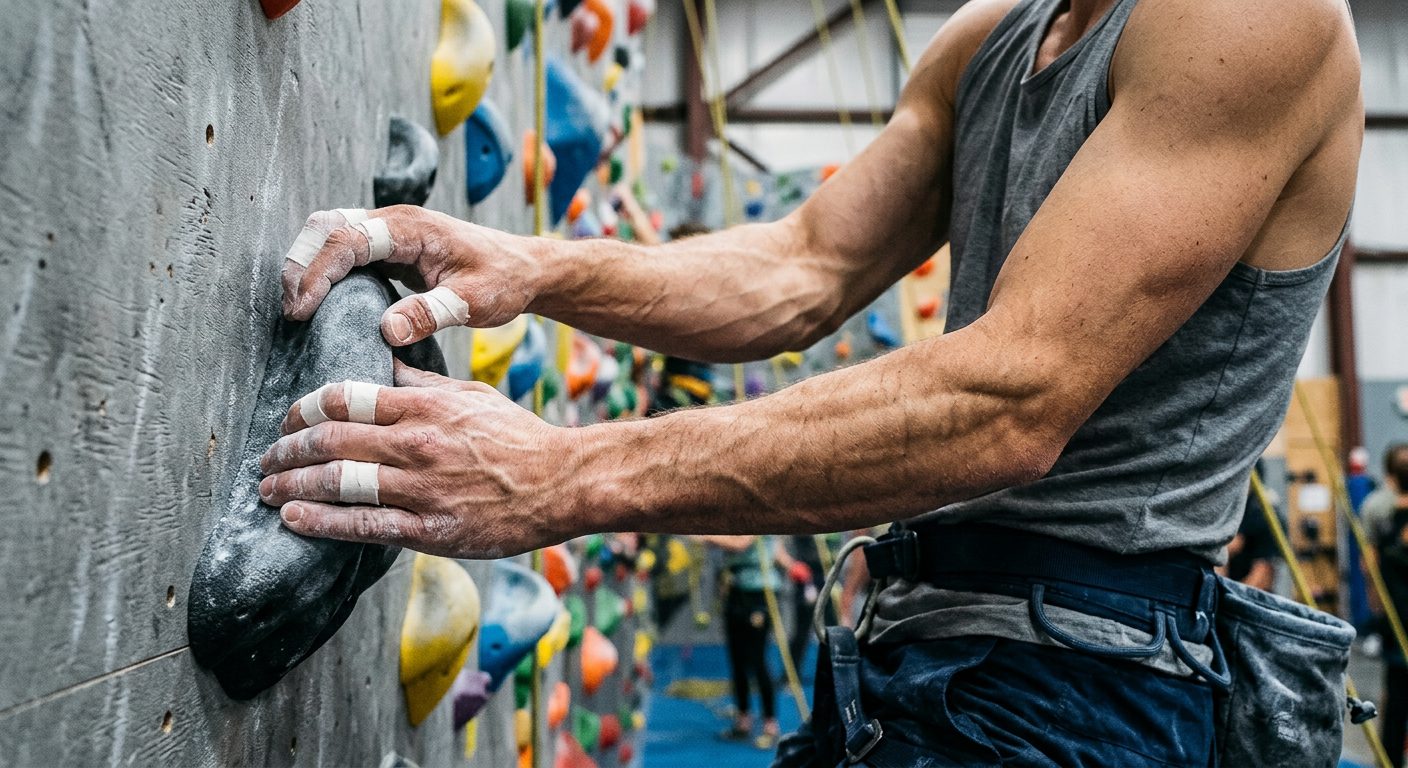
When you hold a static grip the muscle works isometrically: it generates tension without shortening. When you move upwards, concentric contraction comes into play. If you hold on for a long time, your forearms get «pumped»: this is local fatigue, with little local exchange and rapid depletion of the energy available in the muscle.
What happens in the muscle
During effort, the actin and myosin filaments form bridges that generate force. In isometric work the length of the fibre hardly changes, but the tension stays high. This is not an interactive video: it is the reason why, after an intense boulder, your forearms stay hard even back on the ground.
The load on the fingers is unnatural. Among the problems most often mentioned by climbers in Piedmont are flexor tendinitis and injuries to the A2 and A4 pulleys, often after a foot slips while the hand stays in a crimp grip.
Sharp pain in a finger, a snap, swelling or a «pop» during a move: see a doctor or specialist first. Massage does not repair a pulley, does not replace diagnosis or rehabilitation and does not by itself «prevent» tendon injuries.
At the Crigan Massaggi studio in Turin, Mihail Crigan works on the tension of people who train. For the forearms, lats and rotator cuff, the options are sports massage (pre-event or cool-down) and deep tissue massage, with acupressure on the tightest points.
The practical aim: less stiff muscles and a feeling of recovery after sessions at the wall or at the crag. It is not a separate «climber's» protocol distinct from the other treatments: it is the same sports massage, adapted to where you feel fatigue. A session lasts 60 minutes and costs 60 €, by appointment at Via Monginevro 76/F, Borgo San Paolo.
People who climb two or three times a week often consider a monthly recovery session. If the massage is aimed at pain, at least three days are needed between sessions. Standard contraindications: acute injury, wounds, acute inflammation, fever. If in doubt, start with your doctor.
Related reading: sports massage, deep tissue massage, neck massage and the Journal.
People who climb two or three times a week often consider a monthly recovery session. There is no frequency that on its own «prevents» tendinitis.
No. A less tight muscle can move more freely. Strength and technique still come from training and rest.
At Crigan Massaggi a 60-minute session costs 60 €. You can book on +39 334 858 8535 or on WhatsApp.
Google reviews
4,9 / 5
average of 222 reviews
On Google, Crigan Massaggi in Turin has an average of 4,9 out of 5 from 222 reviews. They are public and can be read on the studio listing before you book.
Read reviews on GoogleBy appointment
Tell Mihail Crigan where you feel fatigue: forearms, shoulders or back. At the studio on Via Monginevro 76/F a 60-minute session costs 60 €.