Journal · the Crigan Massaggi blog
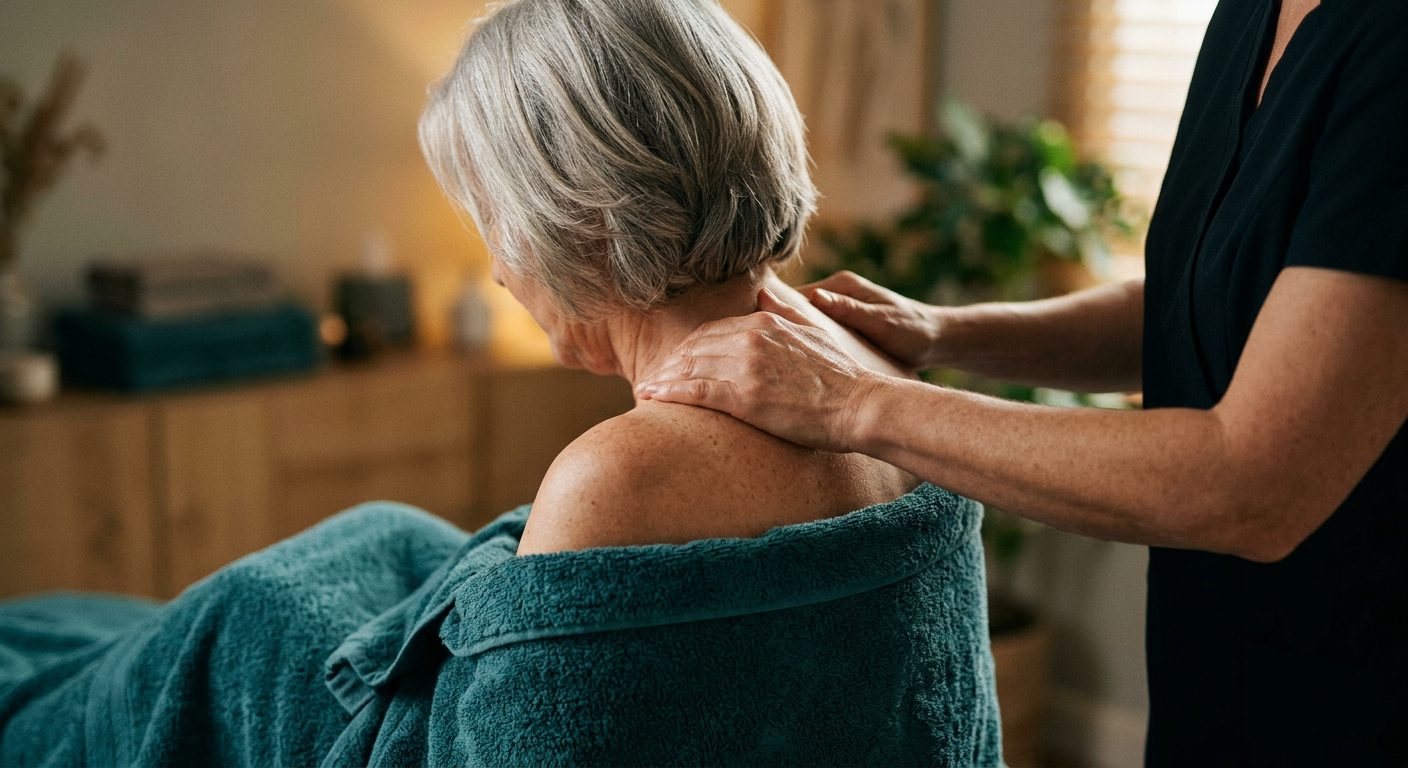
Massage for older people, given by a professional with techniques suited to their age, can support circulation, help keep joints stiffened by arthritis mobile, support posture and muscle tone and bring relief from muscle and joint pain. Massage is also a moment of contact, attention and presence, which is precious when sight and hearing weaken. Before starting, always ask your GP for advice, especially with osteoporosis, severe varicose veins or other conditions.

By Mihail Crigan, sports massage practitioner in Turin · Updated on
In brief
This article is for information only. The Crigan Massaggi studio treats adults by appointment; for people over 65 Mihail adapts the pressure and, if there are treatments or conditions, asks for the doctor's go-ahead.
Later life
Massage is a gradual manipulation of the body that stimulates its different parts: a very common practice in the world of wellbeing and, in some of its forms, also used in healthcare.
There are many types, from therapeutic to sports, holistic or draining massage, often designed for specific groups among which older people rarely appear. Yet it is precisely after 65 that massage, combined with an active lifestyle and functional exercise, can become a real ally against the effects of age.
The value of touch
With ageing the senses gradually weaken, especially sight and hearing. Touch, on the other hand, remains present and is little affected by age: that is why physical contact can help soften the consequences of this loss.
Through contact, a massage gives an older person a moment of attention and presence, dedicated to them alone.
Benefits
As well as on a psychological level, massage works above all on a physical one. A well-performed massage can:
It stimulates blood circulation, which helps you feel looser when you move.
It helps preserve the mobility of joints, which are often stiffened by arthritis or rheumatic diseases.
It helps maintain good posture.
It can bring relief from rheumatic, muscle and joint pain.
It helps maintain muscle elasticity and tone and, together with physical activity, counter the natural loss of muscle mass that comes with age.
It can contribute to better digestion.
It can be useful with water retention and varicose veins, but only with gentle techniques and the doctor's go-ahead.
Relaxation and general wellbeing can also indirectly support the body's defences: a help, not a cure.
Performed by an experienced professional and with the consent of your GP, massage can also complement the treatment of some disorders typical of later life, such as arthritis or diseases of the spine. It never replaces prescribed treatment.
Safety
Possible contraindications should always be assessed by your GP, who knows the person's history and current treatments.
With osteoporosis, severe varicose veins or other conditions gentle techniques and the doctor's go-ahead are needed; deep techniques should be avoided.
Each technique also has its own contraindications, listed on the pages for the individual massages. For example:
If in doubt, always ask your doctor before booking.
Care homes
Older people living in nursing or care homes deserve a separate mention. For them, physical contact can help improve physical wellbeing, mood and motivation, and the simple fact of being looked after makes them feel valued.
Massage thus becomes a form of dialogue: the person giving the massage can respectfully convey the pleasant feeling of being welcomed, recognised, helped and supported, especially if they are open and understanding and listen with genuine interest to what the person communicates.
Dementia
Dementias are among the most common diseases in old age. In these degenerative diseases the person gradually loses contact with their surroundings, until they no longer recognise their loved ones or their own environment, and speaking and understanding words also become more and more difficult.
The channel of touch, however, stays open. Massage can be used not only to support functional rehabilitation, but also as a form of sensory communication, always in agreement with the doctor and with the person's carers.
The source cited
A study by Rowe and Alfred, published in 1999 in the Journal of Gerontological Nursing, assessed a slow-stroke massage given by people caring at home for someone with Alzheimer's disease: some physical expressions of agitation improved, such as pacing up and down, but not the verbal ones.
Read the study abstract on PubMed
Mihail Crigan's view
Sports massage practitioner, DIABASI® diploma
With an older person the watchword is gentleness: gradual, never painful techniques, after the go-ahead from the GP, who also helps choose the technique according to any contraindications. Every session at Crigan Massaggi begins by listening to the person's complaint and habits; if a more accurate assessment is needed, a consultation with a physiotherapist and a physiatrist is possible, thanks to the collaboration with Dr Oriano Casamenti of STUDIO RONEFOR.
Crigan Massaggi sees clients by appointment at Via Monginevro 76/F, 10141 Turin (TO): 60 minutes cost 60 € and the length can be agreed. For a course of several sessions there is the 10-massage package at 50 € per session.
FAQ
Massage for older people can support circulation, help keep joints stiffened by arthritis or rheumatic diseases mobile, support posture and muscle tone and bring relief from muscle, joint and rheumatic pain. It also offers a moment of contact and attention, which is precious when sight and hearing weaken.
Yes, and they should always be assessed with your GP. With osteoporosis, severe varicose veins or other conditions, gentle techniques and the doctor's go-ahead are needed; deep techniques should be avoided. Some techniques are not recommended, for example, with heart conditions, venous thrombosis, anticoagulant therapy or high blood pressure.
With dementia the person gradually loses contact with their surroundings and with words, but the channel of touch stays open: massage can become a form of sensory communication, to be agreed with the doctor and with the person's carers. A 1999 study of people with Alzheimer's found that a slow-stroke massage reduced physical agitation but not verbal agitation.
It depends on the person and on the doctor's opinion, but gentle, painless techniques are generally chosen. At Crigan Massaggi, for example, Ayurvedic massage is designed for people with a low pain threshold and manual lymphatic drainage for water retention, always taking their respective contraindications into account.
At Crigan Massaggi, at Via Monginevro 76/F in Turin, every massage costs 60 € for a 60-minute session, by appointment on +39 334 858 8535; the length can be agreed. With the 10-massage package each session costs 50 €.
Google reviews
4,9 / 5
average of 222 reviews
On Google, Crigan Massaggi in Turin has an average of 4,9 out of 5 from 222 reviews. They are public and can be read on the studio listing before you book.
Read reviews on GoogleBy appointment
Crigan Massaggi, Via Monginevro 76/F: 60 minutes for 60 €, by appointment. Before the session, ask your GP for advice.